
Introduction
Carrier bag is a bag made of paper or plastic for holding customer’s purchases. It is also known as ‘shopping bag’ and ‘retail bag’.
How Carrier bags made?
Carrier bags are mainly made from paper or plastic. Nowadays, most plastic carrier bags are made of polyethylene (low-density or more “crinkly” high-density). Plastic bags hold up better than paper bags when wet, such as in rain. Plastic bags are commonly reused as either garbage bags, or can be recycled along with other plastic containers.
Types of Carrier Bags (plastic and paper)
- Punched or patched handle carriers – the handle punched into the top of the bag making these bags better suited to lightweight goods. For extra strength a patch of polythene is added to reinforce it.
- Varigauge carriers – similar to patch handle carriers but made from thicker film near top handle and thinner at bottom.
- Clip close carriers – made using low and high density polythene with fitted executive style rigid clip close handle.
- Flexiloop handle carrier – stronger than a punched handle but still a cost-effective option, the handle is attached separately.
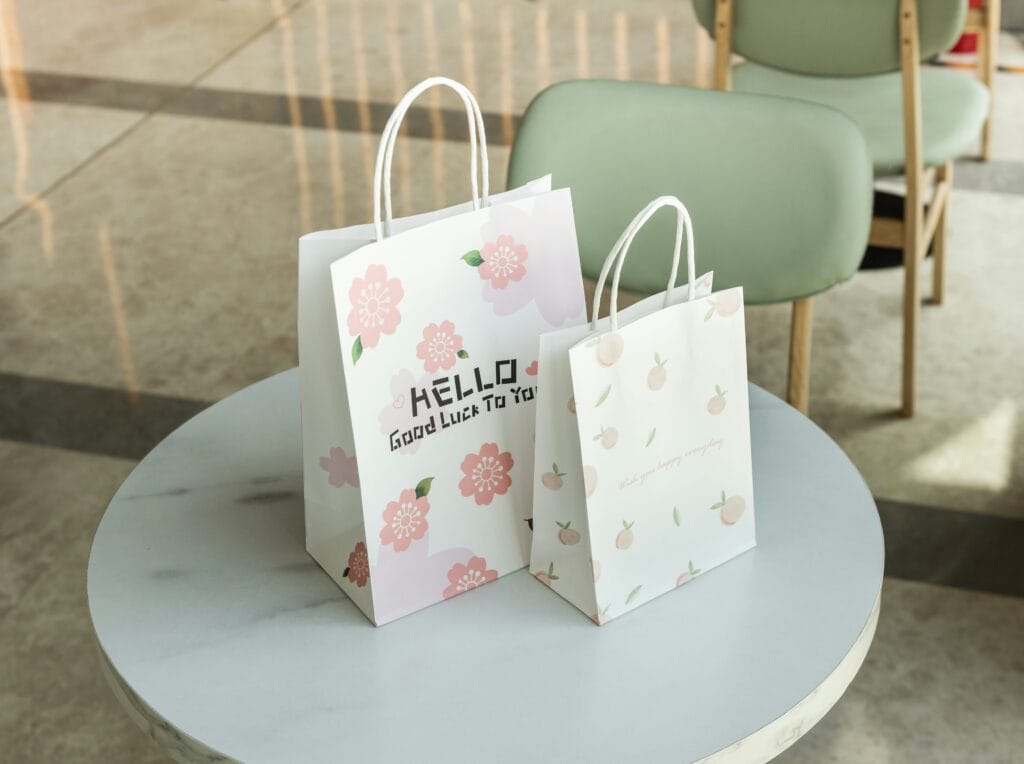
- Twisted string or rope handle – separate string or rope handle gives this carrier a slightly more up market look and raises the price too. Can be made from paper or plastic.
- Duffle bag – a more modern shape bag with a big capacity, popular for making a younger, more stylish impression. A strong promotional tool made from heavier polythene with a welded turnover top and twisted rope that draws the carrier closed.
- Counter bag – used for ‘first contact’ with food for sandwich shops, butchers, delicatessens etc., made in paper or polythene.
- Vest style or t-shirt carriers – A side gusseted carrier bag made from strong high density polythene which resists punctures and tears. Ideal and economical choice to hold books, groceries and T-shirts.
Major UK suppliers:
Product specifications
Options for Carrier bags
- Clear or Coloured
- Plain or Printed
Available Thickness:
80 Gauge (20microns) to 1000 Gauge (250microns)
Common materials used for Carrier bags:
- Plastics – Low density polythene or High density polythene
- Recycled plastic or paper carrier bags
- Biodegradable carrier bags
- Paper
- Cotton
Tolerances:
Normally, Carrier bags in Great Britain should follow widely accepted industrial standards according to British Standard – see BS7344, 1990
- Width: Plus or minus 3mm (0.125″) or 2% whichever is greater
- Length: Plus or minus 6mm (0.25″) or 2% whichever is greater
- Gauge: Plus or minus 10%
Standards for ‘Carrier bags’ to use for food contact and medical application
Food Contact – To use Carrier bags inside European Union, in contact with food should comply with the relevant legislation on food contact including Great Britain.
- Great Britain: Statutory Instrument, 1998 No. 1376 and BPF-BIBRA (1995), Polymer Specification 4, Polyethylene
- EU: Commission Directive 90/128/EEC, 92/39/EEC, 93/9/EEC, 95/3/EEC and 96/11/EC, Section A.
- Example of a company comply with food contact: Polybags Limited
Medical use – Similarly, to use Carrier bags inside European Union, to produce containers for preparations for medico-pharmaceutical purposes should comply with the following regulation:
- European Pharmacopoeia – Monograph 3.1.3 “Polyolefin’s” for medico-pharmaceutical purposes.
- The final responsibility for the decision of whether a material is fit for a particular application lies with the pharmaceutical firm.
- Example of a company comply with medical use: Polybags Limited
Common uses of Carrier Bags
- Bags for retail goods
- Bags to hold books, groceries and t-shirt
- Bags for merchandise and presentation (trade shows, seminars and promotions)
- Bags to protect shoes and promotional items
- Bags for presentation of beauty products, stationery and gifts
- Bags for restaurant carry out
Tips for acquiring ‘Carrier bags’ most cost-effectively
As carriers are an essential part of any business with products to sell – both in terms of practicality and as an advertising tool for your company. As a result you will need to think about the most cost-effective means of acquiring them. So consider followings:
What do I need?
That is, questions to first ask yourself and then to find out from the manufacturers in your search for the perfect carrier.
What size and weight of products will be going into the bag?
This is important, as you may need different sizes or thickness or particularly strong handles. It may also affect whether you can have paper or polythene carriers.
Do I want my logo on it?
This will be more expensive but it will promote your name and image outside the business. A striking bag is an effective advertisement for the company.
How many will I need?
You may be restricted by a minimum order or it may be that you will have a high turnover, will all your products need separate bags?
How much of my budget can go to carriers?
This is where you weigh up the other questions. For example you need stronger bags so you might not be able to have so many colours on them. What is most important to your business?
Once you’ve armed yourself with some of these details it’s time to find someone who will make the bags for you.
Buy Common Carrier bags
- White Patch Handle Carriers
- Clear patch and Clip close handle Carriers
- Coloured patch handle carriers
- Vest style carriers
- Paper carriers
- Flexiloop Grocery Re-usable Carrier Bag
- Biodegradable Carriers
Creative use of ‘Used plastic shopping bags’
Canadians give new life to used plastic shopping bags As an industry, we have put out a call to all Canadians to re-use and recycle their plastic shopping bags … to use them wisely for everything they are worth. The Canadian plastics industry wants its plastic shopping bags back so they can be remade into exciting new products.
Decima Research shows that Canadians are embracing re-use and recycling of their plastic shopping bags, with over 90 per cent of people currently re-using their bags and over 80 per cent indicating that they would recycle those bags they do not reuse if given the opportunity at retail.
And the story continues… One 2×6 composite board 16 feet long uses about 2,250 plastic shopping bags in its manufacture.
Canadian businesses are doing their part as well… innovating and finding new uses for used bags and other plastics…
- A Newfoundland company, Enviroplastic Lumber, makes picnic tables for Gros Morne National Park, a United Nations recognized World Heritage site.
- A Chatham firm has developed a look-alike cedar shingle, called Enviroshake, from a proprietary composition of recycled plastic, recycled rubber and agricultural-fibre materials, such as flax and hemp… the roofing material comes with a 50-year warranty.
- Cascades a Quebec-based firm uses recycled plastic shopping bags to manufacture plastic lumber called “Perma Deck”, some furniture and some industrial products. Northern Plastic Lumber of Lindsay, Ontario manufactures “Plasboard”, a 100% recycled plastic lumber. And Rival Inventory Control of Newmarket, Ontario and Awax Manufacturing of Calgary, Alberta manufacture plastic lumber.
- Canadian Recycled Plastic Products, of Stratford, Ontario makes Muskoka-styled chairs, furniture, trash containers, recycling bins.
- In the United States, Virginia-based Trex Company purchases about 300 million pounds (136 million kilograms) of used polyethylene a year for manufacturing composite lumber decking and railing products.
FACTS – Answers to ‘Environmental Issues Concerning Carrier Bags’
- LITTER – Plastic carrier bags are not a litter problem. In fact most litter on our streets is snack food packaging, bottles and cans, cigarette ends and similar. It is estimated that plastic bags of any kind make up far less than 1% of litter on our streets. So reducing the number of plastic carrier bags we use will make no difference to the volume of litter on our streets.
- LANDFILL – Even if plastic carrier bags end up in landfill they take up an insignificant amount of space. The material that takes up most space in our landfills is paper and wood-based products and putrescible waste. As any waste expert will confirm, these are the materials that can become a major contributor to greenhouse emissions and groundwater pollution – not plastic.
- FINITE OIL RESOURCES – Forget the popular environmental “spin”. Compared with alternatives, lightweight high-strength plastics represent by far the best overall use of valuable earth resources for thousands of everyday applications. The benefits to the environment are incalculable. Only about 2% of all the oil consumed in Europe is used for all plastic films – and plastic carriers are a very small part of this percentage. The vast majority of oil – nearly 85% – is burned as fuel in cars and lorries or as heating fuel. A carrier bag tax will make absolutely no difference to global oil consumption.
- ENERGY – The energy intensity of plastic carrier bags has been shown to be far less than for the equivalent size of paper bag. So plastic films are the most energy-efficient material we can produce. After use, the latent energy in plastic can be recovered by re-use, recycling or via waste to energy systems as widely practised throughout the EU.
- RESOURCE MINIMISATION – Today’s plastic carrier uses 70% less plastic than 20 years ago yet still remains as strong and durable. No other industry has achieved this reduction in material used. So why penalise an industry that has the best track record of all in resource minimisation?
- TRANSPORTATION, STORAGE AND FUEL EMISSIONS – Plastic is by far the lightest of all carrier bag materials – so it takes much less fuel to transport and creates less damaging exhaust emissions than any alternative. A paper bag weights roughly six times more than a plastic carrier, is about four times more expensive and takes up to ten time more storage space. Plastic has genuine environmental advantages across its full life cycle.
- RE-USE AND RECYCLING – Plastic carrier bags are re-used time and time again. Estimates suggest that four out of five people re-use single trip plastic carrier bags in the household. Replacing these bags would cost more in resources and energy – a plastic bag tax introduced elsewhere is resulting in a massive increase in the sale of plastic refuse bags and bin liners! Plastic film is recyclable so why not encourage markets for recycled plastic carriers instead of taxing them?
- CONVENIENCE AND THEFT REDUCTION – Plastic carrier have proved to be the solution of convenience for both the shopper and retailer. Imagine the queues building up at checkout when those in front have forgotten to bring alternative carriers. Or the delays and embarrassment when supermarkets need to search customers’ own bags to combat increased pilfering. Think of the extra cost to supermarkets – many of whom replace accidental breakages on their premises – when people using old or damaged bags spill the contents everywhere. Imagine the costs and chaos when supermarket plastic and wire baskets are stolen – as is happening elsewhere – as a substitute for the carrier bag. And think how the supermarkets will feel about their goods being carried out in competitor branded bags! Above all we must never forget we are predominantly handling food and groceries, where cleanliness and hygiene are crucial. Heavy duty re-usable bags may sound like a good idea but should we really be gambling with the nation’s health?
- ANTI COMPETITIVE AND A BARRIER TO TRADE – A tax on plastic carrier bags would be extremely unfair. It would discriminate against plastic compared with other materials. It could represent a serious restraint on trade – putting our businesses and jobs at risk – and for no environmental gain. A plastic bag tax would effectively close down dozens of UK carrier bag manufacturers for no good reason – killing off hundreds of jobs and wasting millions of pounds of investment which has ironically been spent on meeting UK legislation for better health, safety and a cleaner environment.
Reference: ‘Environmental Issues Concerning Carrier Bags’ – The Carrier Bag Consortium
Carrier bags cartoons
- And for my next trick, I shall attempt to open a supermarket carrier bag without losing my temper.
- Man leaving a ‘Sex Shop’ with groceries in a bag shaped like a pair of breasts
- Do you want a bag with that?
- There’s no charge for the carrier bag!
Carrier bag Joke
Michael Jackson: What’s the difference between Michael Jackson and a carrier bag?
One is made of plastic and is a potential risk to children. The other carries.
Carrier Bag News
In praise of a hidden household hero by Jane Bickerstaffe
Anger over plastic bags is misplaced, says Jane Bickerstaffe in The Green Room this week. Their environmental impact is negligible, she argues, and taxing them can cause more serious damage.
Packaging has a tiny environmental impact compared with the impact of heating our homes and using private transport, let alone flying
The humble and much maligned thin plastic carrier bag is at least as much a household hero as the pantomime villain it is often (mis)cast to be.
A recent UK government-funded initiative to look at ways to reduce use of thin bags found that people don’t want more re-usable “Bags for Life” – they already have plenty in their homes – they just forget to take them to the shops!
Surely, though, it’s not that difficult if we are planning a shopping trip to remember to take our own bags.
We manage when we are on holiday in Italy or Spain, where the practice is more commonplace.
It might be different on ad-hoc trips, but still it is not necessary to always accept a new bag. One national UK pharmacy chain has trained its staff to ask customers whether they really need a bag.
Small impacts
HAVE YOUR SAY
Send us your comments
All packaging (including carrier bags) has a tiny environmental impact compared with the impact of heating our homes and using private transport, let alone flying.
Putting a tax on carrier bags does nothing to help the environment. It simply adds costs and penalises those who can least afford to pay – the elderly and those without cars.
Another argument commonly directed against plastic bags is that they do not quickly degrade in landfill. These bags represent just 0.3% of household waste sent to landfill and the fact that they are relatively inert and stable is an advantage.
Biodegradable waste, on the other hand, such as potato peelings, some degradable plastics, junk mail and newspapers, does break down in landfill and releases greenhouse gases. This is why a European Landfill Directive has set targets to reduce the amount of biodegradable material landfilled.
However, a number of governments around the world are considering introducing, or have introduced, taxes or bans on plastic carrier bags. The reasons vary according to the country.
Has Ireland’s plastic bag tax increased the use of lorries? The Irish Government, for example, claimed that the sole purpose of taxing plastic bags was to solve a litter problem.
Yet two years after the introduction of the tax, plastic carrier bags still constituted 0.25% of litter according to the Irish Litter Monitoring Body.
In the UK, with no such tax, they were only 0.06% of litter, according to a survey commissioned by Incpen and carried out by Encams, the charity which runs the Keep Britain Tidy campaign.
In any case, there is no excuse for littering anything in countries where the authorities provide a waste management infrastructure.
In countries such as Rwanda and Bangladesh where plastic bags have been banned because they clog drains and exacerbate flooding, the problem arises because there is no such infrastructure.
In the short term, banning bags may be necessary to help reduce flooding, but the best solution is to manage waste properly and enable the public to dispose of all waste responsibly.
Re-used not recycled
According to the UK government’s environment department, over 80% of plastic bags are re-used by British households.
Bags represent just 0.3% of household waste sent to landfill and the fact that they are relatively inert and stable is an advantage. Once a bag has completed its task of transporting purchases from shop to home, it becomes a bin liner, a disposable nappy bag, or something to carry muddy football boots in.
In practice, the tax in Ireland has actually had a negative effect on the environment.
Deprived of thin bags, people have had to buy tailor-made bags. Tesco reports selling 80% more pedal bin liners and SuperQuinn supermarket 84% more disposable nappy bags; these are thicker and use more resources.
Marks & Spencer reports using three times as many lorries to transport alternative bags to their Irish stores with a resulting rise in exhaust emissions and traffic nuisance.
So let’s not be too hard on the thin plastic carrier bag. We can use it for its original purpose and then re-use it for lots of other things when we get it home.
Jane Bickerstaffe is director of Incpen, the Industry Council for Packaging and the Environment, in the UK. Incpen aims to analyse and minimise the environmental and social impacts of packaging.
The Green Room is a series of opinion pieces on environmental issues running weekly on the BBC News website.
Reference: http://news.bbc.co.uk/1/hi/sci/tech/4836766.stmPLASTIC BAG TAX – THE ISSUES
Interest in a potential tax on plastic carrier bags has been aroused in the UK following the implementation of such a tax in the Republic of Ireland in 2002. There has also been in interest in Scotland, where a Member of the Scottish Parliament, Mike Pringle, is calling for legislation to obligate local authorities to introduce bag taxes.
The BPF represents the whole plastics supply chain in the UK, including polymer producers, distributors and suppliers, additives suppliers, processors – including those involved in packaging, machinery suppliers and recyclers. This section of the BPF website endorses the views of PIFA (Packaging and Industrial Films Association).
A SUMMARY OF BPF’S POSITION ON PLASTIC CARRIER BAGS and LITTER – A BACKGROUND TO THE ISSUES
Are plastic carrier bags a litter problem? No, in the UK, plastic carrier bags are not a serious litter issue. Firstly, litter is a problem of social behaviour, and is not specific to any one material or product. For many years the BPF has been a member of ENCAMS (formerly known as the Tidy Britain Group) to support litter education programmes, surveys and campaigns. Consumers are encouraged to re-use and then dispose of their bags responsibly. Some stores now run bag recycling schemes.
Secondly, plastic carrier bags are not a significant component of litter in the UK, studies have shown that bags probably make up less than 1% of litter, and that cigarette butts are by far the highest proportion of litter.
Plastic bags are useful and provide a hygienic, odourless, waterproof, robust and convenient way of carrying goods. Because of their strength and durability plastics bags can be re-used time and time again, either for a similar purpose or a wide range of other uses. As the NOP survey, commissioned by DEFRA in 2000, amply illustrates, more than 80 per cent re-use their plastic carrier bags, a high re-use rate for consumer packaging.
Why taxing plastic bags is a non-starter
The BPF believes there would be little logic in taxing plastic carrier bags, as they are not a significant litter problem and they do not represent a significant environmental impact.
Just 4% of crude oil consumption is used for all plastics, and only 2% for all films, of which plastic bags is a very small proportion. 85% of oil is burned as fuel or heating.
Plastic bags are extraordinarily energy-efficient in manufacture, and more so than paper bags. Not only do they prevent waste of goods carried, but the embodied energy can be recovered either by recycling or via energy-from-waste systems.
Plastic carriers are lightweight, convenient and popular. A tax would discriminate unjustly against plastics and would represent an anti-competitive move and a serious restraint on trade, damaging jobs and an industry already battling against over-regulation and under-investment.
Reference: ‘Plastic Bag Tax – The Issues’, British Plastics Federation
Read – What people say about Carrier Bag Taxes
What people say about Carrier Bag Taxes
Alongside the popular spin that carrier bag taxes would help the environment, there is a growing understanding of the real issues and an increasing recognition that such a tax would be just a token and trivial environmental move. Here are some recent views from the public and media.
“… a tax on plastic bags would only address a small part of the waste stream instead of using an economic instrument that would have a wider impact. We doubt that such a tax would decrease plastic bag waste.”
The Local Authority Recycling Advisory Committee (LARAC)
“The experience in the Republic of Ireland has demonstrated that a tax on plastic bags has unintended consequences. Consumer demand for paper bags in high street stores has led to severe environmental costs in terms of transport and fuel usage as they take up ten times the storage volume of plastic bags.”
The Scottish Retail Consortium
“We do not believe that a carrier bag tax is the right way forward and believe carrier re-use is more effective” says Nick Manger-Godfrey, Head of Environmental Management, Waitrose.
Organic Business, January 2003.
Following the decision by the Local Government Association (LGA) to lobby for a plastic bag tax to raise public awareness of waste issues, the BRC (British Retail Consortium) has said the levy already operating in Ireland has not seen a real change in plastics consumption.
The BRC said the Irish Plastic bag tax has created other problems since its introduction in 2002 including a 1000% increase in the consumption of bin liners and a rise in shoplifting. It has also seen many shops switch to providing paper carrier bags which are exempt from the material-specific tax.
Nigel Smith, BRC’s Corporate Social Responsibility Director, explained: “If you go out to Ireland and speak to the retailers they, on the whole, would welcome a plastic bag tax. But for high street shopping there is more impact because it is more spontaneous, unlike a supermarket where people can plan and take their own bags.”
He added that in Ireland many high street shops have switched to using paper bags which are more bulky than plastic bags and therefore have transportation and storage issues. “This means four times as much traffic on the roads carting around paper bags.” he said.
Nigel Smith, BRC’s Corporate Social Responsibility Director
“How dare this Government try to rip people off by charging 9p for supermarket carrier bags and then sugar coating their little scam by pretending it’s to protect the environment? This pathetic excuse for yet another electorate rip-off comes with the excuse that in Ireland, where the scheme has been piloted, the streets were littered with carrier bags that take years to decompose – and now they’re not.
Well I don’t buy it. I live in London where there are 17 million people and I have never seen empty carrier bags dumped in the streets. If this Government wants to protect the environment, why don’t they tell George Bush, whose country is responsible for nearly 30% of the world’s greenhouse gases, to clean up his act first…”
Reference: Carole Malone Column. Sunday Mirror. 12 May 2002“Forget Prada handbags and fancy designer shopping bags – the humble supermarket carrier bag is this year’s favourite fashion accessory. According to research out today from the Department of the Environment, Transport and the Regions “are you doing your bit?” campaign, the supermarket carrier bag is the that bag that most people would choose to be seen using again and again in public – for everything from carrying their own gym kit to a stroll down the high street. The new research has revealed the supermarket carrier bag to be the most popular plastic bag to re-use – even more popular than designer bags such as Harrods or Gucci, and bags from fashionable high street stores such as Gap and Next.”
DEFRA News Release 650. 18 October 2000
“If the aim were to tackle the litter problem, it would be misguided, as it would fail to address the fundamental cause of litter – people’s behaviour. The solution to litter has to be a comprehensive approach aimed at changing attitudes and behaviour. Such an approach would address all litter through a combination of public education, enforcement of the litter laws and local authority cleansing programmes. Any other approach would at best be piecemeal and at worst condone anti-social behaviour.”
Industry Council for Packaging in the Environment, Position Paper on Possible UK Plastic Carrier Bag Tax. May 2002
“The Environment Minister is confusing litter with domestic waste. Plastic shopping bags form a relatively small percentage of the litter decorating many British streets and roadside verges. By far the largest amount of litter is discarded take away food wrappings, cigarette packs and drink containers.
Mark Lyons. Ashford, Middlesex.
“The reality of the carrier bag’s role in the overall litter problem is by no means proven as even the consultants who carried out the Irish research acknowledge. As so often in these cases, the perception may be at variance with the true facts”
Editorial Comment PRW magazine. 10 May 2002
“A return to paper bags at retailer checkouts instead of plastic seems… a backward step as far as both consumer convenience and the environment are concerned… the reality from the environmental point of view which, after all is what this debate is all about, is that paper sacks have considerable disadvantages in terms of greater weight, energy use and higher emissions. Studies show that paper bags weigh as much as four times more than their plastic counterparts and take up substantially more space. Not only does this add to transport and storage costs – and the related knock on environmental effects – but it could give local authorities major problems in complying with the Landfill Directive.”
Editorial Comment Packaging News magazine. June 2002
“We recycle plastic bags as bin liners. If such free plastic bags are taxed then our family will end up buying just as many plastic bags in the form of purpose-made bin liners (which are generally not as good).
David Ward, Bristol
“The almost complete disappearance of plastic bags from Ireland’s convenience stores… has led to unexpected problems… the public has been stealing plastic baskets… used to collect the goods in the shop before packing them into their shopping bags. It has been found that some customers have accumulated up to six of them and they do not bring them back. Another problem is that when customers bring their own large bags, it has been found that these facilitate shoplifting. It has also been noticed that, because of the absence of plastic bags, the customer who arrives without a bag may end up buying less.”
Environment Watch magazine 19 July 2002
“What is the sense in imposing a green tax on supermarkets – the sector that has done most to reduce inefficiency and waste in retail distribution during the past 50 years. Packaging has reduced the amount of food that rots before it reaches the consumers . Superstores have also revolutionised distribution, cutting the number of road journeys that would be needed to stock smaller shops. In contrast local authorities in charge of household waste collection are grossly inefficient, yet push up their prices ahead of inflation year on year. Wouldn’t it be better to levy a 9p tax on council excuses?
S.D. Smith. Riccall. North Yorkshire.
“If there is to be a tax on carrier bags to cut down on waste and pollution, it should be extended to include the biggest street pollutant – MacDonalds cartons.”
Duncan Barnes. Croydon, Surrey
“How will my family transport the weekly shop from the Supermarket to home?
By using reusable bags? – No, I don’t think so. They will be dirty from prior use and, in time, smelly – Not very hygienic.
By using Cotton carriers? – No, I don’t think so. They will absorb spilt milk and smell disgusting – Not very hygienic.
By using paper bags? – No, I don’t think so. The American check-out paper bag has all but disappeared (along with the forests), No handles!!
By using paper carriers? – No, I don’t think so. Paper handled carriers are just not strong enough, would fail with moisture from thawing frozen foods and use up trees!
By using old cartons? – No, I don’t think so. Why would I want to put my groceries into a recycled carton? Strictly speaking, not allowed to have direct contact with food.
By using black bin bags? – No, I don’t think so. Made from recycled carriers and, therefore, unacceptable for food contact.
By using existing carriers costing 5-10p? No, I don’t think so. Why should we specifically pay for something which has been a free service provided by the stores?
Let’s just stay with the current system and let’s ensure they don’t litter the countryside.”
A Concerned Shopper
“The Packaging Federation and its members play an active part in interfacing with Government on data and consultations, compliance scheme operations, and importantly, physically investing in recycling. Thus, producer responsibility is embraced. However, this goodwill should not be abused by extending the current system on a piece-meal basis through stealth taxes on products such as carrier bags and bottles. As seen elsewhere in Europe, these tend to have longer-term negative impacts – environmental and fiscal.”
The Packaging Federation Response to the Cabinet Office Strategy Unit Discussion Paper on Waste.
“I don’t believe it would be popular with customers because they don’t want to pay for a carrier bag. Anecdotally, when they get to a checkout they will do things like get a rucksack out and load it. Then, when they can’t fit everything in, they will have to unload it. So you’ll then have tremendous problems with the time customers spend queuing at checkout, adding enormous amounts of time to their shopping trip”.
“… On the one hand there’s the carrier bag, which weighs a very small amount and uses little plastic. On the other, we find people feeling that they would like to borrow a trolley or shopping basket to take home their shopping.”
“… We’ve designed a plastic tray that is reusable and has a lifetime of at least ten years. At the end of that lifetime, it gets shredded and recycled to make new trays.”
Leonie Smith, Corporate Social Responsibility Manager at Tesco in “Resource” Magazine Sept/Oct 2002.
“There is no obvious benefit to a bag tax, which seems to be part of a rather arbitrary approach to the problem of recycling. Taxing shoppers for their bags is only displacing the problem.”
Andrew Simmons, Chief Executive, Recoup.
Reference: ‘The Carrier Bag Tax – What People Say’ – The Carrier Bag Consortium
Carrier bag tax sparks EU row – Times Online
Carrier bag tax sparks EU row by Robert Winnett and Nicola Smith
The French vice-president of the European Union has become embroiled in a conflict of interest row after lobbying Peter Mandelson to impose new duties on imported plastic bags.
After a flurry of e-mails from Jacques Barrot, Mandelson, the EU trade commissioner, issued proposals last month to tax the cheap imports from the Far East.
However, Barrot – who as the French transport commissioner would not be expected to involve himself in trade issues – has for the past 30 years been president of a trade association that represents the plastics industry in his home region of Haute-Loire.
The EU code of conduct for commissioners states that they may hold “honorary positions” in public interest organisations but “posts held on these terms shall under no circumstances involve any risk of a conflict of interest”.
A spokesman for Barrot repeatedly changed his account of the commissioner’s conduct when asked about his role last week. He initially said, after checking with the trade association, that Barrot had resigned his position last month.
After questions were put to Mandelson’s office, another spokesman said Barrot had resigned last year but remained as honorary president until June. He then retracted this claim too.
Barrot refused to release a copy of a resignation letter that he claimed to have sent and this weekend the trade association’s website still listed him as its president.
Sources close to Mandelson confirmed yesterday that he had been lobbied by Barrot.
A spokesman for Mandelson said that it was “entirely normal and acceptable” for fellow commissioners to put across their point of view.
British retailers and foreign plastic bag manufacturers are baffled by the commission’s actions. Mandelson can impose import duties only if foreign manufacturers are seen to be “dumping” their products in Europe at below cost price.
A commission inquiry initiated by Mandelson found earlier this year that some Far Eastern factories were illegally dumping bags on the EU market. They now face variable duties up to 15%.
To trigger an investigation, the trade commissioner has to receive complaints from Europe-based manufacturers representing more than 25% of the market. However, lawyers claim that investigations are usually launched only when a significantly larger proportion complain.
A letter to the European commission signed by the British Retail Consortium, British Polythene Industries and others said: “We would like to draw your attention to several grave irregularities in the proceedings… the complaint was lodged by only 29 out of the 1,100 known EU producers.”
British retailers say that they will have to pass on the extra cost of carrier bags, which they estimate at £60m, to shoppers. Dustbin liners, freezer bags and other plastic bags will also be hit by the new duties.
Plastic bags imported from the Far East tend to be between 10% and 20% cheaper than those in Europe, reflecting lower raw material and labour costs.
Reference: The Times Online


